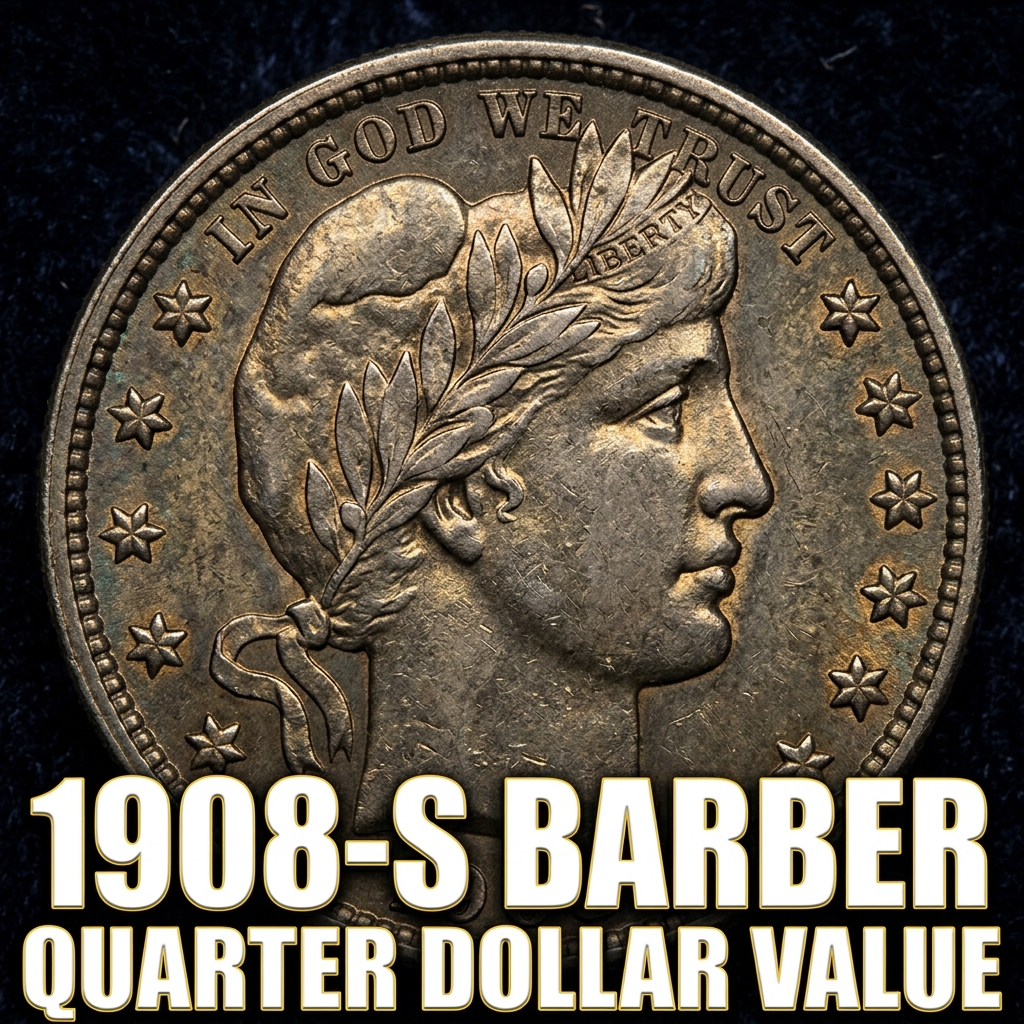
The 1908-S Barber Quarter is worth anywhere from $15 in heavily worn condition to over $1,800 in uncirculated mint state. This San Francisco minted silver coin is a favorite among collectors because it represents a time when American pocket change was made of real precious metal and featured classical artistic designs.
Why the 1908-S Barber Quarter is a Rare Treasure
If you have just found an old quarter with a lady wearing a crown of leaves, you are holding a piece of American history known as the Barber Quarter. Named after its designer, Charles E. Barber, these coins were the workhorses of the early 20th-century economy. The 1908-S version is particularly special because it was struck at the San Francisco Mint, which produced significantly fewer coins than the main mint in Philadelphia. Finding one today in your attic or an old jar of coins is an exciting discovery that could put some extra cash in your pocket.
Because these coins circulated heavily, most examples you find will be quite worn. However, the “S” mint mark on the reverse side elevates its status above the common 1908 quarters without a mark. To get an instant professional look at your find, you can use a free coin identifier app to confirm the variety and check for any rare errors. Using tools like CoinHix can also help you organize your collection and see how the market for silver quarters is performing in real-time.
Standard Market Prices for the 1908-S Quarter
When determining how much your coin is worth, the most important factor is the “grade” or the amount of wear and tear visible on the surface. A 1908-S quarter that is nearly flat with almost no detail left is still worth more than its weight in silver, but a coin where you can clearly read the word “LIBERTY” on the headband is where the value truly starts to climb into the hundreds of dollars. Collectors pay a premium for “originality,” meaning a coin that hasn’t been cleaned or polished with chemicals.
While the quarter is a high-value item, savvy collectors often look at the entire 1908 series. For instance, the 1908 dime value trends show similar growth patterns for San Francisco minted coins of that era. Below is a breakdown of what you can expect to receive for a 1908-S Barber Quarter based on its current condition.
| Condition / Grade | Estimated Market Value |
|---|---|
| Good (G-4) | $15 – $22 |
| Very Good (VG-8) | $35 – $45 |
| Fine (F-12) | $75 – $95 |
| Very Fine (VF-20) | $160 – $190 |
| Extremely Fine (EF-40) | $320 – $380 |
| Uncirculated (MS-60+) | $700 – $1,850+ |
Identifying the S Mint Mark and Mintage Figures
The 1908-S quarter is distinguished by the small capital letter “S” located on the reverse side of the coin. If you flip the quarter over, look at the bottom, just below the eagle’s tail feathers and above the letters “QU” in “QUARTER DOLLAR.” If that “S” is present, you have the San Francisco strike. In 1908, the San Francisco Mint produced only 784,000 of these quarters. Compare that to the Philadelphia Mint, which produced over 4 million, and you can see why the “S” version is much harder to find.
Because these coins are over a century old, many have been lost to silver melts or simple wear. Identifying a genuine 1908-S requires a steady hand and a magnifying glass. If you are unsure if the mint mark is real or if the coin has been altered, the CoinHix app provides high-resolution comparisons to help you verify your coin’s authenticity. This ensures you don’t accidentally sell a rare specimen for the price of a common one.
Tips for Grading Your Barber Silver Quarter
Grading is a subjective art, but for the 1908-S Barber Quarter, there are specific “checkpoints” to look for. In “Good” condition, the rim of the coin should be complete, though the letters might touch it. In “Fine” condition, you should be able to see at least three letters of the word “LIBERTY” on the crown. Once you reach “Extremely Fine,” all letters in “LIBERTY” must be sharp and clear, and the eagle’s feathers on the back should show distinct lines.
Avoid the temptation to clean your coin to make it look “better.” Cleaning removes the natural patina and creates microscopic scratches that can slash the value of a 1908-S quarter by 50% or more. Serious buyers prefer a dirty, authentic coin over a shiny, scrubbed one. If you want a more accurate estimate without visiting a local shop, using CoinHix can guide you through the grading process by comparing your coin’s details to a database of professionally graded examples.
Q: Where is the mint mark on a 1908 Barber Quarter?
A: The mint mark is located on the reverse (back) of the coin, centered directly above the “R” and “D” in the words “QUARTER DOLLAR.” An “S” indicates the San Francisco Mint, while a “D” indicates Denver. No mark means it was minted in Philadelphia.
Q: Is the 1908-S Barber Quarter made of real silver?
A: Yes, all Barber Quarters minted between 1892 and 1916 are composed of 90% silver and 10% copper. This gives them intrinsic “melt value” even if they are in very poor condition.
Q: Does a 1908-S Quarter have any common errors?
A: While there are no major famous die cracks associated with this specific year, collectors always look for “re-punched” mint marks (RPMs) or doubled dies. Using a digital identifier tool can help you spot these tiny variations that might increase the price.