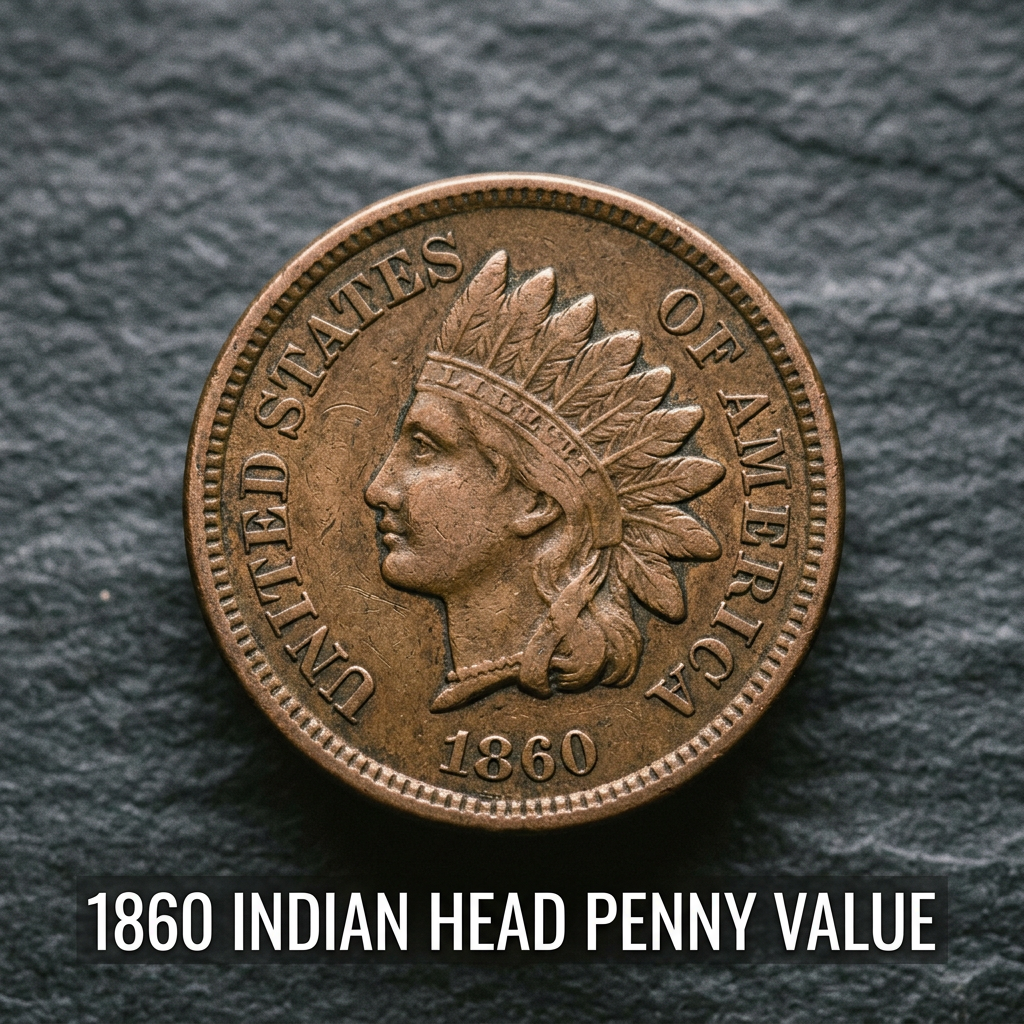
The 1860 Indian Head Penny is worth anywhere from $10 in worn condition to over $350 in choice mint state. Finding one of these bronze-looking treasures in an old jar or inheritance is an exciting moment for any American, as it represents a pivotal era in our nation’s history right before the Civil War.
Understanding the Design and Rarity of the 1860 Indian Head Penny
The year 1860 was only the second year of the Indian Head cent series, and it featured a significant design change from the 1859 version. While the 1859 penny had a laurel wreath, the 1860 version introduced the oak wreath with a small shield at the top. This design would become the standard for decades to follow. If you are unsure if you have a genuine 1860 penny, you can use a free coin identifier app to quickly confirm the date and variety of your find.
These coins were minted in Philadelphia and are composed of 88% copper and 12% nickel, giving them a thicker, paler appearance compared to the “red” pennies we use today. Because they are over 160 years old, most surviving examples are heavily worn. Finding one in high-quality condition is rare, which is why it’s a good idea to check your pocket change with the CoinHix app to ensure you aren’t overlooking a valuable vintage piece.
How Much Is Your 1860 Indian Head Penny Worth Today
The value of an 1860 cent depends almost entirely on its physical condition, also known as its “grade.” A penny that spent years circulating in the economy will be worth significantly less than one that was tucked away in a drawer for a century. For those holding a particularly clean coin with sharp details on the feathers and the word “LIBERTY,” the 1860 Indian Head Cent MS value can reach several hundred dollars or more at auction.
Even in lower grades where the details are smoothed out, these coins remain highly liquid. Collectors are always looking to fill holes in their albums for this specific year because it is considered part of the “Pointed Bust” or “Rounded Bust” transition era. To get a better sense of how this year compares to later dates in the series, you might want to look at the market price for later date Indian Head pennies to see how scarcity impacts the bottom line.
| Condition (Grade) | Estimated Market Value |
|---|---|
| Good (G-4) | $10 – $15 |
| Fine (F-12) | $25 – $35 |
| Extremely Fine (XF-40) | $55 – $75 |
| Uncirculated (MS-60) | $150 – $180 |
| Choice Uncirculated (MS-63) | $250 – $350+ |
Key Factors That Influence 1860 Penny Pricing
The first thing to look at is the “LIBERTY” inscription on the headband. If all seven letters are clearly visible, you are looking at a coin in “Fine” condition or better, which doubles or triples the price immediately. Secondly, check the luster. Original 1860 pennies often have a “copper-nickel” sheen that looks slightly different from modern bronze cents. If the coin still has a mirror-like surface, it could be a Proof strike, which can be worth over $1,000.
Using resources like the CoinHix app can help you identify these subtle nuances. Another factor is the presence of errors. Some 1860 pennies show “doubled die” features on the date or the lettering. These errors are highly sought after by specialists and can command a premium over the standard price guide listings. Always inspect your coin under a magnifying glass before deciding to sell it or put it in a flip.
Getting the Most Money for Your Antique Coins
When you are ready to sell or value your collection, never clean your coins. Cleaning an 1860 Indian Head Penny removes the natural patina and can drop the value by 50% or more instantly. Collectors prefer “original” surfaces, even if they are dark or have a bit of dirt. The best approach is to store the penny in a PVC-free plastic holder to prevent further environmental damage.
If you believe your coin is in exceptional condition, consider having it professionally graded by services like PCGS or NGC. A certified grade can make the difference between a $50 sale and a $500 sale. For everyday Americans who just want a quick estimate, the CoinHix app provides a great starting point by comparing your coin’s photos to historical auction data, ensuring you get a fair price for your piece of American history.
Q: Is there a mint mark on the 1860 Indian Head Penny?
A: No, the 1860 Indian Head Penny was only minted in Philadelphia, and at that time, the Philadelphia mint did not use mint marks. If you see a mint mark, it may be a different year or a counterfeit.
Q: What is the metal content of an 1860 penny?
A: It is made of 88% copper and 12% nickel. This “fatty” composition makes the coin thicker and heavier than the thin bronze cents produced after 1864.
Q: How can I tell if my 1860 penny is a Proof?
A: Proof 1860 pennies have very sharp details, square edges, and highly reflective surfaces. Only about 1,000 proof versions were minted, making them extremely rare and valuable compared to circulation strikes.