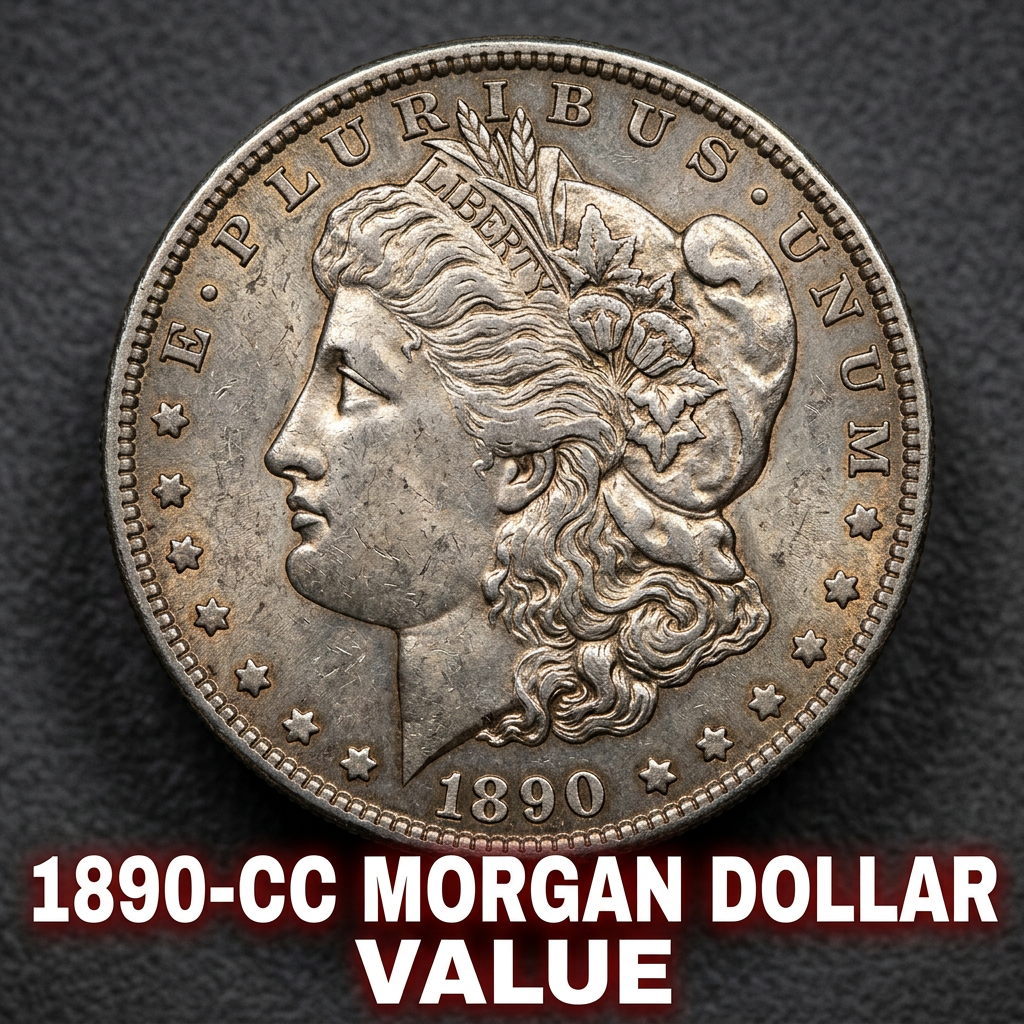
The 1890-CC Morgan Dollar is worth anywhere from $600 in worn condition to over $10,000 in high-grade mint state. Finding one of these heavy silver coins in an old trunk or inheritance is an exciting discovery because every single coin minted in Carson City carries a premium for its history and scarcity.
The History and Scarcity of the Carson City Mint
The Morgan Silver Dollar is the iconic coin of the American West, but none are more legendary than those bearing the “CC” mint mark. These coins were struck at the Carson City Mint in Nevada, right in the heart of silver country near the Comstock Lode. By 1890, the silver boom was aging, but the mint was still busy producing these heavy dollars for circulation. While the Philadelphia and New Orleans mints pumped out millions of coins, the Carson City facility had much lower production runs. This inherent rarity is why collectors are willing to pay a high price for these specific pieces today.
If you have found an old silver dollar and aren’t sure if it’s a CC or another variety, you can use a free coin identifier app to quickly pinpoint the mint mark. Knowing the origin is the first step in determining if you are holding a common $30 coin or a treasure worth hundreds. For those who want to be absolutely sure of their find, using the CoinHix app allows you to scan your coins and get instant details on their historical background and rarity.
How to Identify and Grade Your 1890-CC Silver Dollar
To find the mint mark, look at the reverse (the eagle side) of the coin. Just above the letters “D” and “O” in the word “DOLLAR,” you should see two small “C” letters. If the space is blank, it was made in Philadelphia; an “O” signifies New Orleans. The 1890-CC is particularly sought after because its mintage was only 2,309,041—a relatively low number for the series. However, condition is the biggest factor in the final price tag. Most coins found in jars or drawers are likely “Very Good” to “Extremely Fine,” meaning they show wear on Lady Liberty’s hair and the eagle’s breast feathers.
If the coin looks like it just came from the bank with no wear and a strong luster, you might be looking at a “Mint State” (MS) specimen. These are the coins that reach the five-figure mark at auctions. You can check the current market trends for 1890-CC Morgan Dollar MS auction values to see how much premium quality adds to the price. Because grading can be subjective for beginners, the CoinHix app offers a great way to compare your coin’s appearance to high-resolution images of graded examples.
Current Market Value and Price Chart
The value of a silver dollar is tied to both its bullion content and its numismatic (collector) value. While a common silver dollar might track closely with the price of silver, the 1890-CC is a collector’s item and fluctuates based on demand. Even in “Cull” or heavily damaged condition, an 1890-CC usually sells for several hundred dollars because it is a key date for many collectors completing a set.
To give you a better idea of what to expect when visiting a coin shop or selling online, refer to the detailed 1890-CC silver dollar price data provided by experts. Below is a simplified value chart based on standard grading scales used by professionals.
| Condition (Grade) | Estimated Market Value |
|---|---|
| Good (G-4) | $550 – $650 |
| Fine (F-12) | $750 – $850 |
| Extremely Fine (XF-40) | $1,100 – $1,300 |
| About Uncirculated (AU-50) | $1,600 – $1,900 |
| Mint State (MS-63) | $5,500 – $7,000 |
| Mint State (MS-65+) | $10,000+ |
Tips for Selling and Protecting Your Investment
If you believe you have a genuine 1890-CC Morgan Dollar, the most important rule is: Do not clean it. Many people think they are helping by scrubbing off the dark tarnish or “patina” to make the silver shine, but this actually destroys the coin’s numismatic value. Collectors prefer original surfaces, and harsh cleaning can drop the value of your coin by 50% or more. Instead, handle the coin only by its edges and place it in a PVC-free plastic holder to prevent further scratches.
When you are ready to sell, it is wise to get a second opinion. Tools like the CoinHix app can help you organize your collection and track the value over time as market prices change. For high-value coins like these, professional grading by services like PCGS or NGC is often recommended, as a certified “slabbed” coin is much easier to sell for a top-dollar price than a “raw” coin.
Frequently Asked Questions
Q: Why is the CC mint mark so special on an 1890 dollar?
A: The Carson City Mint produced fewer coins than other locations, and its connection to the “Old West” creates high demand among collectors, making any CC Morgan Dollar much more valuable than Philadelphia or New Orleans versions.
Q: Is every 1890 silver dollar worth a lot of money?
A: No, only those with the “CC” mint mark carry this high premium. 1890 dollars without a mint mark (Philadelphia) or with an “O” (New Orleans) or “S” (San Francisco) are generally worth $30 to $60 in circulated condition.
Q: How can I tell if my 1890-CC Morgan Dollar is a fake?
A: Because of their high value, counterfeits exist. You should check the weight (it should be 26.73 grams) and see if it sticks to a magnet (real silver is not magnetic). Using a professional identification tool or taking it to a reputable dealer is the best way to verify authenticity.