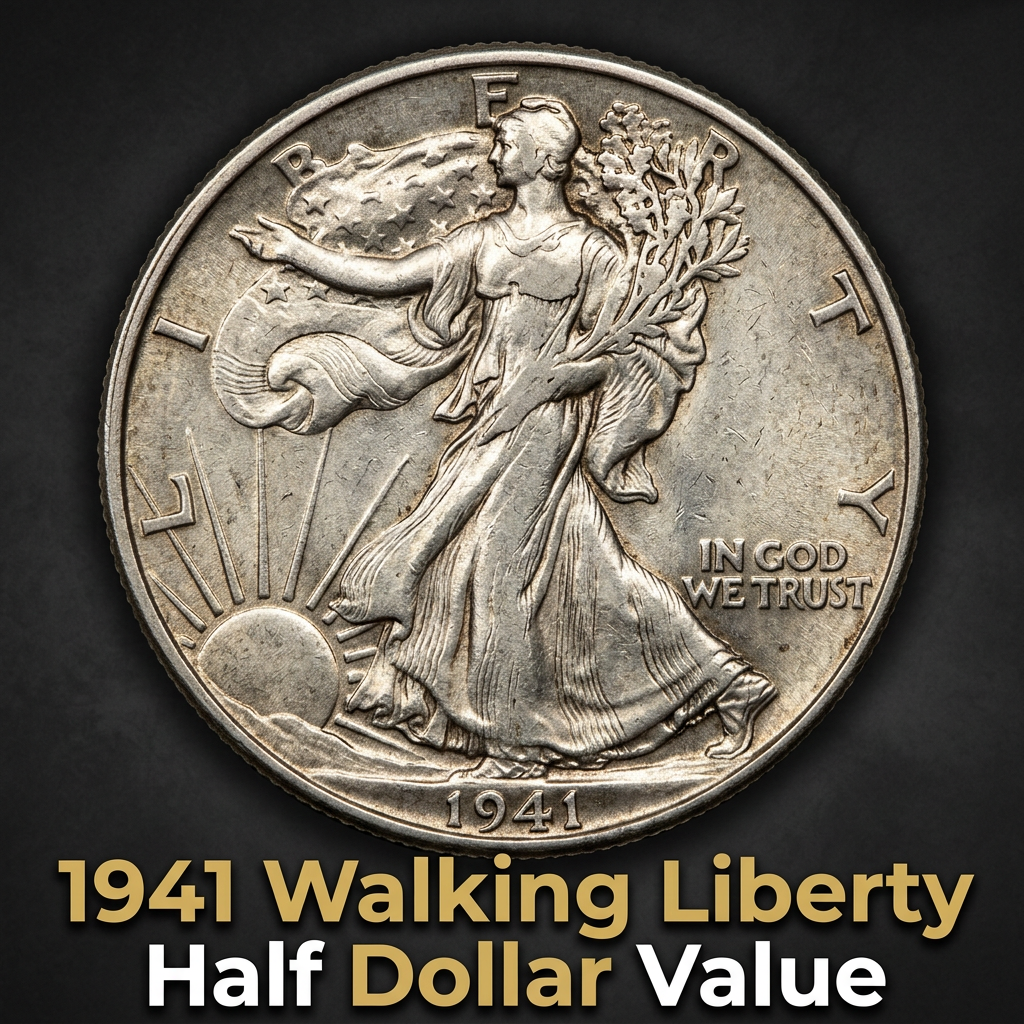
The 1941 Walking Liberty Half Dollar is worth anywhere from $12 in worn condition to over $10,000 in high-grade mint state. Finding one of these heavy silver coins is like holding a piece of American history, and most examples found in jars or old collections carry a value significantly higher than their face value.
Design History and the Silver Content of 1941 Half Dollars
The Walking Liberty design is widely considered the most beautiful image ever placed on a United States coin. Created by Adolph A. Weinman, the obverse features Lady Liberty draped in the American flag, striding toward a rising sun. This iconic design was so beloved that it was later resurrected for the American Silver Eagle bullion program. If you have recently discovered one of these coins, you might want to use a free coin identifier app to confirm its authenticity and check for specific variety markers that could increase its worth.
Beyond its artistic merit, the 1941 half dollar is a “junk silver” favorite because it is composed of 90% silver and 10% copper. Each coin contains approximately 0.36169 ounces of pure silver. This means that even if the coin is completely worn down and has no collector appeal, it will always be worth its “melt value,” which fluctuates with the live price of silver. For those who aren’t sure if their coin is a common date or a rare treasure, tools like CoinHix can provide instant clarity by analyzing the coin’s features through your smartphone camera.
Writing in 1941, the U.S. Mint was ramping up production as the country stood on the brink of entering World War II. Because these coins were used heavily in daily commerce for groceries and war bonds, finding them in “uncirculated” condition is much rarer than finding them with heavy wear. To get a better sense of the market, you can check the latest 1941 Walking Liberty half dollar MS grade prices to see what the highest-quality specimens are currently fetching at auction.
How Mint Marks Affect the 1941 Half Dollar Value
In 1941, three different mints produced these half dollars: Philadelphia, Denver, and San Francisco. Identifying which mint produced your coin is the first step in determining its market price. The Philadelphia mint coins have no mint mark, while the Denver mint used a small “D” and San Francisco used an “S.” You can find these marks on the reverse side of the coin, located near the rim at the lower left, just below the eagle’s branch.
Generally, the Philadelphia mint produced the highest volume (over 24 million), making it the most common. However, even these common dates are highly sought after in pristine condition. If you find a “D” or “S” mark, you are looking at lower mintage numbers, which typically translates to a higher premium. Using a professional tool like CoinHix can help you zoom in on these small letters to ensure you aren’t misreading a dirty or damaged coin.
The difference in value between a Philadelphia and a San Francisco mint coin can be substantial when looking at “Gem” grades. Collectors are always looking for “full strikes,” where the details in Liberty’s hand and the eagle’s feathers are crisp. You can find detailed 1941 Walking Liberty half dollar value information that breaks down the specific scarcity of each mint branch, helping you realize if your pocket change is actually a collector’s prize.
| Condition / Grade | 1941 (No Mint Mark) | 1941-D | 1941-S |
|---|---|---|---|
| Good (Circulated) | $12 – $15 | $12 – $15 | $12 – $15 |
| Fine to Extremely Fine | $18 – $25 | $20 – $35 | $22 – $40 |
| Uncirculated (MS-63) | $55 | $85 | $90 |
| Choice Uncirculated (MS-65+) | $150+ | $250+ | $350+ |
Grading Your 1941 Walking Liberty Half Dollar
Condition is everything in the world of coin collecting. Most 1941 half dollars that people find in old jars will be in “Circulated” condition. This means they have been passed from hand to hand, and Lady Liberty’s gown or the eagle’s breast feathers will appear flat or rubbed smooth. In this state, the value is mostly tied to the silver content plus a small collector premium.
If your coin looks like it just came from the bank, with a bright, frosty luster and no visible scratches, it is likely “Uncirculated.” These coins are graded on a scale from 60 to 70. A 1941 half dollar in MS-67 (Mint State 67) is an elite rarity and can sell for thousands of dollars at major auctions. Because minor scuffs can mean the difference between a $100 coin and a $1,000 coin, many users rely on the CoinHix app to get a preliminary grade before sending their coins to a professional grading service like PCGS or NGC.
When grading your own coin, look at the lines in Liberty’s skirt. In high-grade specimens, these lines are distinct and sharp. On the reverse, look at the eagle’s left wing. If the feathers are distinct rather than a solid patch of silver, you likely have a coin in “About Uncirculated” or “Mint State” condition. Always handle these coins by the edges to avoid getting finger oils on the surfaces, which can damage the luster over time.
Valuable Varieties and Proof 1941 Half Dollars
In addition to the standard business strikes intended for circulation, the Philadelphia mint also produced “Proof” versions of the 1941 Walking Liberty Half Dollar. Proof coins were made specifically for collectors using specially polished dies and planchets. These coins have a mirror-like finish and are incredibly sharp in detail. A 1941 Proof half dollar is a prized possession and can easily exceed $500 to $1,000 depending on the lack of “haze” or scratches on the surface.
There are also a few varieties to keep an eye out for. While 1941 isn’t known for major “doubled die” errors like other years, minor re-punched mint marks or small die cracks can still attract specialists. These small errors often require a magnifying glass or a high-quality digital microscope to see.
If you are ever in doubt about what you have found, the best course of action is to research similar sales and use modern technology to identify the specific attributes of your coin. Whether you have a common circulated piece or a sparkling uncirculated gem, the 1941 Walking Liberty remains one of the most iconic symbols of American numismatic history.
Q: Is a 1941 half dollar 100% silver?
A: No, it is 90% silver and 10% copper. This was the standard composition for American silver coins (dimes, quarters, and half dollars) until 1965.
Q: Where is the mint mark on a 1941 Walking Liberty half dollar?
A: The mint mark (a small D or S) is located on the back of the coin (reverse), on the lower left side near the rim, just below the branch the eagle is perched on. If there is no letter, it was minted in Philadelphia.
Q: Should I clean my 1941 silver half dollar to make it worth more?
A: Absolutely not! You should never clean old coins. Cleaning leaves microscopic scratches that ruin the coin’s “numismatic” value, often reducing its worth to just its silver melt value. Collectors prefer original toning and patina.