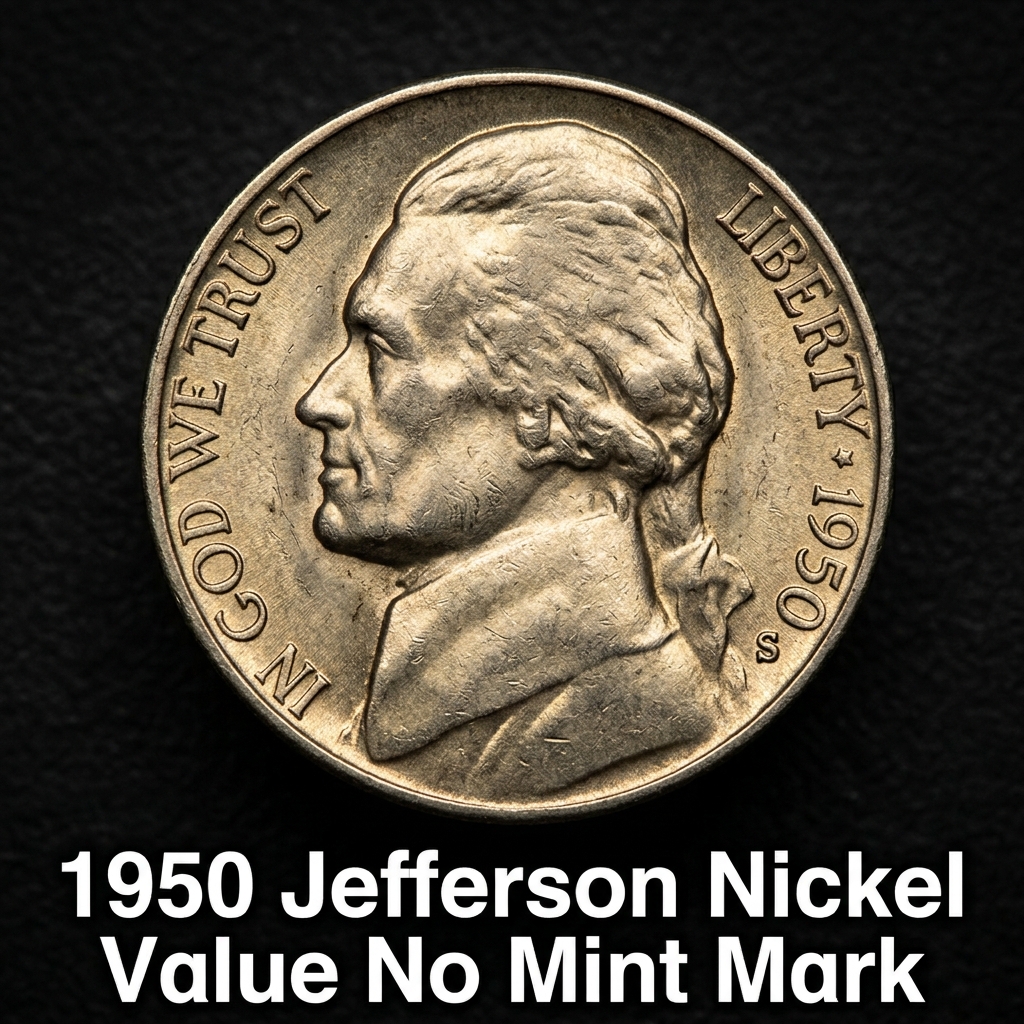
The 1950 Jefferson Nickel with no mint mark is worth anywhere from $0.25 in worn condition to over $600 in premium uncirculated grades. If you have found one of these vintage five-cent pieces in your pocket change or an old jar, you are likely wondering if you have stumbled upon a hidden rarity or just a common piece of pocket change.
Understanding the Philadelphia 1950 Jefferson Nickel
In the world of United States coinage, the absence of a mint mark usually indicates that the coin was struck at the Philadelphia Mint. During the mid-20th century, Philadelphia was the primary hub for nickel production. In 1950, while the Denver Mint produced a famously low quantity of nickels, the Philadelphia Mint struck nearly 10 million pieces.
Because of this relatively healthy mintage, the 1950 nickel without a mint mark is far more common than its “D” counterpart. However, this does not mean it lacks value. Over the decades, many of these coins were lost to circulation or worn down through heavy use. Finding one today in high-quality condition is a treat for any casual collector. To help you determine the specific state of your coin, you might consider using the CoinHix app for a quick visual scan.
How Much Is a 1950 Nickel Without a Mint Mark Worth Today
The market value for a 1950 nickel is largely determined by its numerical grade. Most coins found in circulation today fall into the “Good” to “Fine” categories. These coins show significant wear on Thomas Jefferson’s hair and the pillars of Monticello on the reverse. For these circulated specimens, the value usually stays close to the face value, perhaps reaching $0.50 for a clean example.
However, the price trajectory changes significantly once we reach “About Uncirculated” or “Mint State” conditions. If your coin looks like it just came from the bank, its value can climb into the double digits. For those looking for precise market data, the 1950 nickel MS grade pricing shows that coins with “Full Steps” on the reverse command the highest premiums. Full Steps refers to the crispness of the lines leading up to Monticello, which is a key indicator of a high-quality strike.
| Condition / Grade | Estimated Value (USD) |
|---|---|
| Good (G-4) to Fine (F-12) | $0.15 – $0.50 |
| Extremely Fine (EF-40) | $1.25 – $2.50 |
| About Uncirculated (AU-50) | $3.00 – $8.00 |
| Uncirculated (MS-63) | $15.00 – $25.00 |
| Gem Uncirculated (MS-65 Full Steps) | $80.00 – $150.00+ |
Key Factors Influencing the 1950 No Mint Mark Nickel Value
When assessing your coin, three main factors will determine if it is worth more than five cents: luster, strike quality, and surface marks. Luster is the “glow” of the original mint frost. If the coin is dull or gray, it has likely been circulated. Strike quality refers to how well the metal filled the die; a sharp, detailed image of Jefferson is much more desirable.
Lastly, contact marks—the tiny nicks and scratches caused by coins hitting each other in bags—can lower the grade. If you are unsure whether your coin is a high-grade specimen or just an average find, checking the comprehensive 1950 nickel value guide can provide additional context on historical auction records. The CoinHix app can also assist in identifying these minute details through high-resolution photo analysis.
The Search for Philadelphia Proof Nickels from 1950
While the standard “no mint mark” nickels were made for circulation, the Philadelphia Mint also produced nearly 51,386 Proof nickels in 1950. These were sold in sets directly to collectors and were never intended to be spent. Proof coins are distinguished by their mirror-like backgrounds and frosted details.
If you happen to find a 1950 nickel that looks exceptionally shiny, like a mirror, you might have a Proof specimen. These are significantly more valuable than standard business strikes, often starting at $40 and reaching several hundred dollars for “Deep Cameo” examples. To track the value of such rarities over time, the CoinHix app offers a convenient way to build your digital inventory and watch market trends.
Q: Is the 1950 nickel with no mint mark rare?
A: No, it is not considered rare. With over 9.7 million produced, it is much more common than the 1950-D (Denver) nickel, which is the “King” of the Jefferson series with only 2.6 million struck.
Q: Where is the mint mark located on a 1950 nickel?
A: If it had one, it would be located on the reverse side (the back), to the right of the Monticello building. Since your coin has “no mint mark,” that space will simply be smooth metal.
Q: Should I clean my 1950 Jefferson nickel to make it worth more?
A: Never clean your coins! Collectors prefer original patina and luster. Cleaning or polishing a coin creates microscopic scratches that permanently damage its numismatic value and can make it worthless to serious buyers.