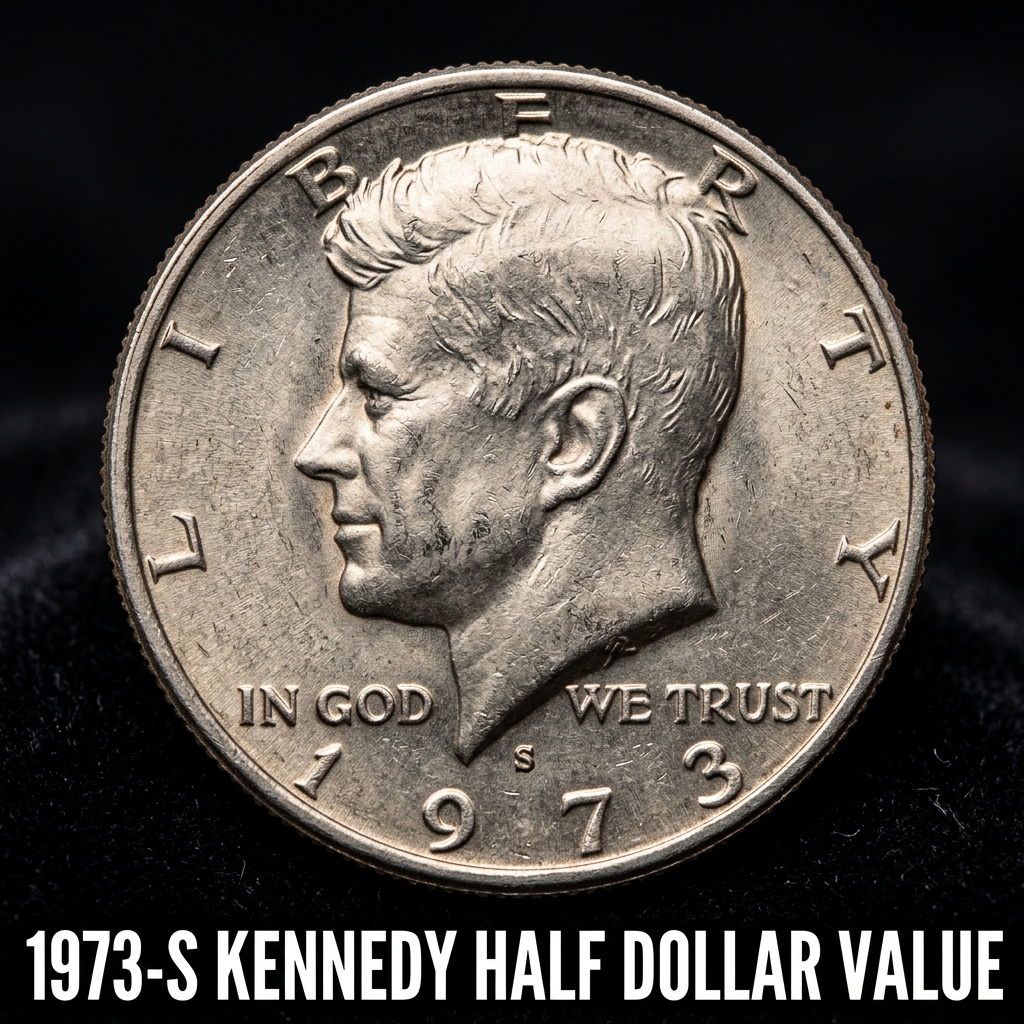
The 1973-S Kennedy Half Dollar is worth anywhere from $3 in typical proof condition to over $1,000 for rare high-grade Deep Cameo specimens. Finding one of these shiny coins in a drawer or an inherited collection is an exciting moment for many Americans because their mirror-like finish stands out immediately from regular pocket change.
History and Identifying Your 1973-S Kennedy Half Dollar
By 1973, the United States Mint had fully transitioned the Kennedy Half Dollar from silver to a copper-nickel clad composition for circulation. However, the San Francisco Mint continued a special tradition by producing “Proof” coins specifically for collectors. You can identify these coins by looking for the small “S” mint mark located just above the date on the obverse (front) of the coin.
If you are unsure whether your coin is a rare proof or just a shiny circulated piece, you can use a free coin identifier app to get instant clarification. These apps help everyday people distinguish between the various mint marks and finishes.
Unlike the coins minted in Philadelphia or Denver that year, the 1973-S was never intended to be spent at a grocery store. They were sold in high-quality plastic cases as part of annual Proof Sets. If you found one in change, it likely escaped from a set and is considered an “impaired proof,” which lowers the value but still makes it a neat find for any casual collector using the CoinHix app to track their treasures.
Current Market Value and Pricing Tiers
The value of a 1973-S Kennedy Half Dollar depends almost entirely on its physical condition and the quality of the “cameo” effect—the contrast between the frosted portrait of JFK and the shiny background. Most 1973-S halves found today remain in their original packaging, keeping their value relatively stable.
For those looking for data on professional grading, the 1973 Kennedy Half Dollar auction records show that coins in perfect PF 70 condition are the ones that truly command premium prices. Most casual collectors will find their coins fall into the $3 to $10 range depending on how well they have been preserved over the decades.
| Condition Grade | Estimated Value |
|---|---|
| PR 65 (Standard Proof) | $3.50 – $5.00 |
| PR 67 Cameo | $8.00 – $12.00 |
| PR 69 Deep Cameo | $25.00 – $45.00 |
| PR 70 Deep Cameo | $800.00+ |
Factors That Influence the 1973-S Proof Value
The primary factor driving the price is the designation given by grading services like PCGS or NGC. A “Deep Cameo” (DCAM) or “Ultra Cameo” (UCAM) coin looks like a black-and-white photograph because the frost on the design is so thick. These are highly sought after by serious numismatists.
If your coin has scratches, fingerprints, or “haze” (a cloudy film that develops on the metal), the value will stay on the lower end of the spectrum. You can check the 1973 half dollar value guide to see how tiny imperfections can impact the final price.
Many people use the CoinHix app to take high-resolution photos of their coins to see if the details are sharp enough to justify the cost of professional grading. Remember, if a coin is only worth $5, spending $30 to $50 to have it graded is usually not a good investment.
Are There Any 1973-S Errors to Look For
While 1973-S Proofs are known for their high quality, errors can still occur. Some collectors look for “Doubled Die” varieties, where parts of the lettering or the date appear to have a faint secondary image. These are quite rare for the 1973-S specifically, but they can double or triple the value of the coin instantly.
Another thing to watch for is “striking errors,” such as a coin being struck through a piece of thread or grease, which leaves a strange indentation on the surface. While these aren’t common in the controlled environment of the San Francisco Mint, they are the “holy grail” for error hunters using CoinHix to identify rare variations.
Even without an error, the 1973-S remains a staple of American coinage history, representing the mid-point of the Kennedy series before the special 1776-1976 Bicentennial designs were released. It is a beautiful piece of Americana that is affordable for beginners while still offering high-end goals for expert collectors.
Q: Is the 1973-S Kennedy Half Dollar made of silver?
A: No, the 1973-S Kennedy Half Dollar is a copper-nickel clad coin. The US Mint stopped using 40% silver for half dollars after 1970.
Q: How can I tell if my 1973-S is a “Deep Cameo”?
A: A Deep Cameo coin will have a very heavy, white frosted appearance on the portrait of JFK and the eagle, which contrasts sharply against a mirror-like, dark background.
Q: Where is the “S” mint mark located on the coin?
A: The “S” mint mark is located on the obverse (front) of the coin, centered just above the “1973” date.