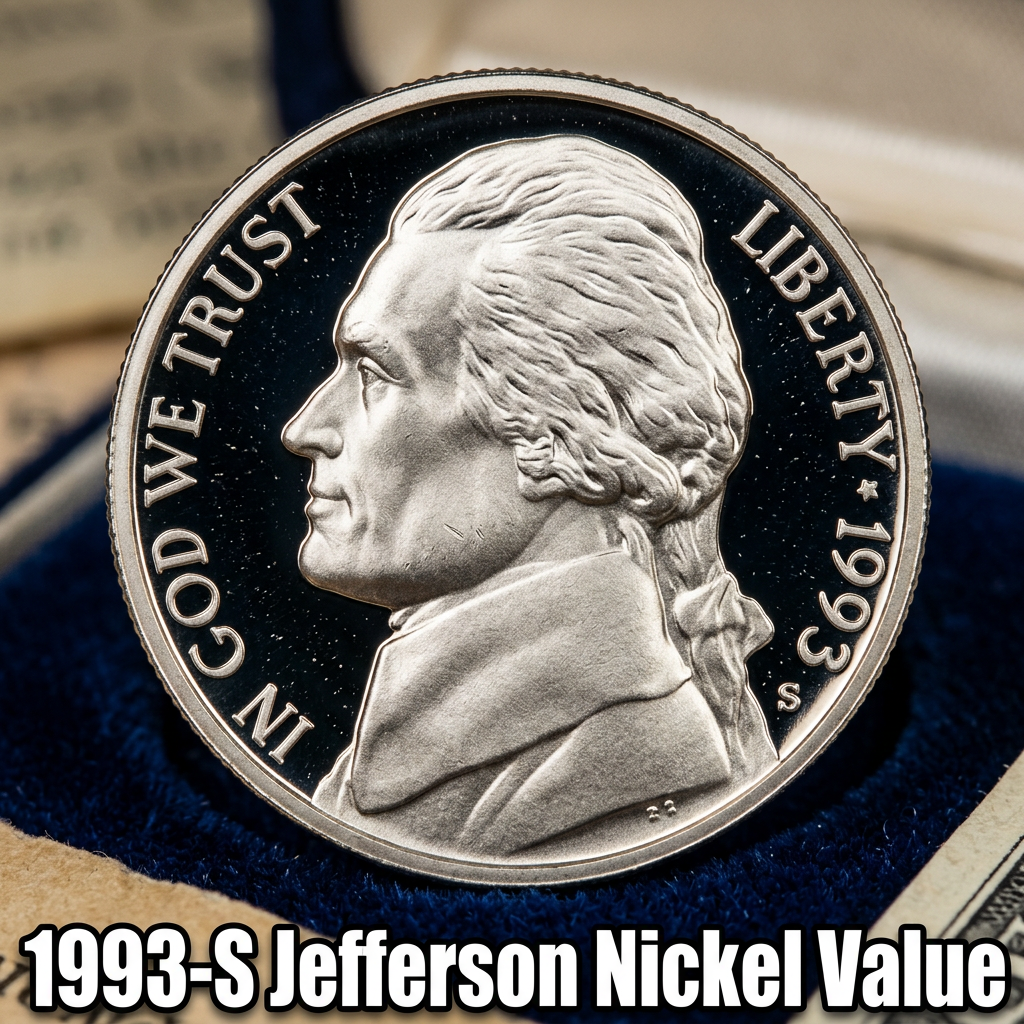
The 1993-S Jefferson Nickel is worth anywhere from $3 in typical Proof condition to over $50 for high-grade Deep Cameo specimens. While you won’t find this specific coin in your pocket change, it remains a popular and affordable piece for everyday Americans looking to expand their coin collections.
Understanding the Special Nature of the 1993-S Nickel
To understand the value of this coin, you first need to know that the “S” mint mark stands for San Francisco. Unlike the nickels you use at the vending machine, the 1993-S was never intended for circulation. These were struck specifically for collectors as “Proof” coins. They feature a mirror-like background and frosted details, making them stand out significantly from a standard nickel. If you have found a shiny 1993 nickel with an “S” on the right side of Monticello, you are holding a piece of numismatic history. To quickly verify what you have, you can use a free coin identifier app to check the mint mark and strike type.
Most of these coins were sold by the US Mint in specialized Proof Sets. Because they were handled with care by collectors, most 1993-S nickels remain in excellent condition today. However, if yours has scratches or fingerprints, the value may stay closer to the lower end of the spectrum. To get an accurate reading on your specific coin’s potential market price, many hobbyists use the CoinHix app to track recent auction trends.
Grading and the Impact on 1993-S Proof Value
In the world of coin collecting, condition is everything. Proof coins are graded on a scale from 1 to 70. For the 1993-S, most examples fall into the PR68 or PR69 category. A perfect PR70 Deep Cameo (DCAM) is the holy grail for this year, sometimes fetching a significant premium at auction. The “Deep Cameo” designation refers to the high contrast between the shiny fields and the milky, white appearance of Thomas Jefferson’s portrait.
While the “S” mint mark is desired, collectors also look at the standard 1993-P and 1993-D versions. While those are common, a high-grade business strike can sometimes be more elusive than a Proof. You can compare the differences in 1993 Jefferson Nickel market prices to see how the S-mint compares to its Philadelphia and Denver counterparts. Generally, the 1993-S is valued for its aesthetics rather than its scarcity, as over 3.3 million were produced.
1993-S Jefferson Nickel Price Reference Table
Below is a breakdown of what you can expect to pay or receive for a 1993-S Jefferson Nickel based on its professional grade. Keep in mind that these prices represent coins that have been graded by services like PCGS or NGC.
| Condition/Grade | Estimated Value (USD) |
|---|---|
| PR65 Deep Cameo (Average) | $3.00 – $5.00 |
| PR68 Deep Cameo | $8.00 – $12.00 |
| PR69 Deep Cameo | $15.00 – $25.00 |
| PR70 Deep Cameo (Perfect) | $45.00 – $110.00 |
What to Look For When Examining Your 1993 Nickel
If you are sifting through a jar of change or looking at a family heirloom, look closely at the surface of the coin. A 1993-S should look like a tiny mirror. If the coin looks “cloudy” or has orange-brown spots (known as toning), it might decrease the eye appeal for some buyers, though some collectors actually pay more for unique rainbow toning. If you are unsure if your coin is a proof or just a very clean business strike, the CoinHix app can help you identify the strike characteristics using your smartphone camera.
The 1993-S is part of the long-running Jefferson Nickel series that began in 1938. Because the design didn’t change much for decades, casual observers often overlook these modern proofs. However, for those building a “Date and Mint” set, the 1993-S is a mandatory addition. You can find more detailed 1993 nickel value and variety information to help you determine if your coin has any rare mint errors, such as double dies or planchet flaws, which could skyrocket the value.
The Future Value of 1993 Jefferson Nickels
Modern proof coins like the 1993-S tend to have very stable values. Because they were minted in large quantities and saved by the public, they aren’t “rare” in the traditional sense. However, as older Proof Sets are broken open and coins are lost or damaged, the supply of pristine, high-grade examples slowly diminishes. This makes “Perfect 70” graded coins a decent long-term hold for hobbyists.
Whether you are a seasoned collector or just someone who found a shiny coin in a drawer, the 1993-S is a great entry point into the hobby. It’s beautiful, historical, and affordable. Using tools like CoinHix makes it easier than ever to manage your collection and ensure you aren’t accidentally spending a coin that is worth much more than five cents.
Q: Can I find a 1993-S Nickel in my pocket change?
A: It is very rare. Since they were only sold in sets, a 1993-S in circulation is usually a “stolen” coin from a set or one that was spent by someone who didn’t know its value. If you find one, it will likely be scratched and worth less than a pristine Proof.
Q: What makes the 1993-S different from the 1993-P?
A: The “S” mint mark indicates it was made in San Francisco as a Proof coin with a mirror-like finish. The “P” (Philadelphia) and “D” (Denver) coins were made for general circulation and have a matte, duller finish.
Q: Is it worth getting my 1993-S Nickel professionally graded?
A: Generally, it is only worth the cost of professional grading (which can be $20-$50) if the coin is in absolutely flawless, PR70 condition. If there are any visible scratches, the cost of grading will likely exceed the value of the coin.