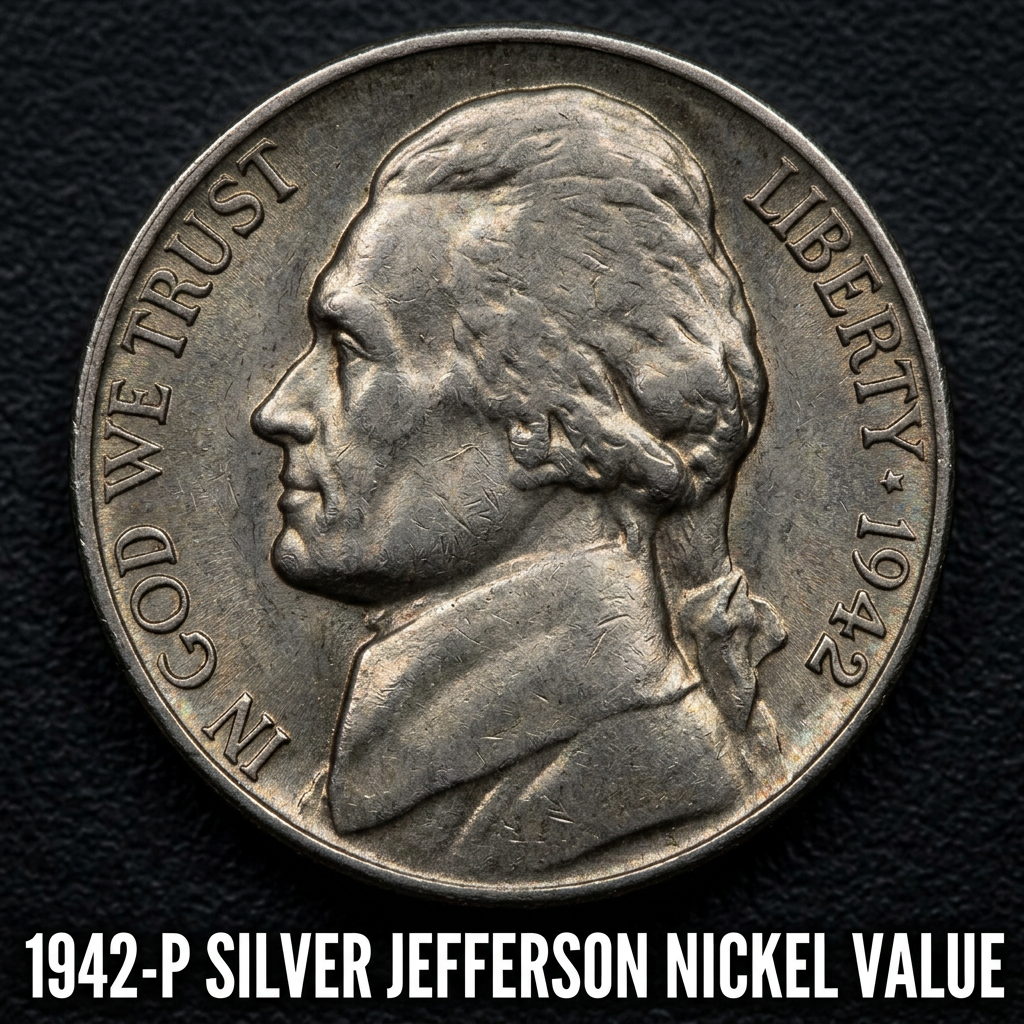
The 1942-P Silver Jefferson Nickel is worth anywhere from $1.50 in worn condition to over $1,000 in high-grade mint state. This historic coin marks a pivotal moment in American history when the U.S. Mint changed its metal composition to support the war effort during World War II.
History of the 1942 P Silver War Nickel
The year 1942 was a transition year for the United States Mint. Before October of that year, nickels were made of the traditional 75% copper and 25% nickel alloy. However, as the United States entered the thick of World War II, nickel became a critical strategic metal needed for armor plating and tanks. To conserve this resource, Congress authorized a change in the alloy.
Starting in late 1942, the composition shifted to 56% copper, 35% silver, and 9% manganese. These coins are now famously known as “War Nickels.” You can easily identify them by the large “P” mint mark located above the dome of Monticello on the reverse side. If you aren’t sure which version you have, you can use a free coin identifier app to quickly distinguish between the copper-nickel and silver varieties.
Using the CoinHix app can also help you see high-resolution images of these different mintages. The 1942-P was the first time in history that the Philadelphia mint used a mint mark on a coin, making it a unique piece for any collector to hold.
Determining the Condition and Grading of Your 1942 P Nickel
To know exactly what your coin is worth, you must look at its condition. Coin collectors use a scale from 1 to 70. Most 1942-P nickels found in change today are in “Good” to “Fine” condition, meaning they have significant wear on Jefferson’s hair and the pillars of Monticello.
Check the hair detail near Jefferson’s ear and the steps on the back of the building. If the steps are clearly visible and sharp, the coin is likely in “Uncirculated” or “Mint State” condition. These high-grade coins are where the real value lies. Professional graders look for “Full Steps” (FS), which refers to the five or six distinct lines on the base of Monticello.
If you find a coin that looks brand new with a bright luster, you might be looking at a much higher 1942-P silver nickel price in MS65 or higher. Many people use the CoinHix app to compare their finds against professional grade photos to get a ballpark estimate of the grade before sending it off to a service like PCGS or NGC.
1942 P Silver Nickel Value Chart
Understanding the market price requires looking at how condition affects the bottom line. Silver prices fluctuate, which provides a “floor” for the value of these coins, but numismatic rarity is what drives the top-end prices.
| Condition Grade | Estimated Market Value |
|---|---|
| Good (G-4) to Fine (F-12) | $1.50 – $2.50 |
| Extremely Fine (EF-40) | $3.00 – $6.00 |
| About Uncirculated (AU-50) | $8.00 – $12.00 |
| Mint State (MS-63) | $25.00 – $45.00 |
| Mint State (MS-66) Full Steps | $150.00 – $350.00+ |
Rarity and Special Varieties to Look For
While most 1942-P nickels are common, there are specific varieties that can skyrocket in price. The most famous is the “1942-P Over 1” doubled die. This occurred when a 1942 hub was impressed over a 1941 hub. If you see the faint remains of a “1” underneath the “2” in the date, you have found a very rare treasure.
Another thing to look for is the “Lamination Error.” Because the wartime alloy was a new experiment, the metal didn’t always mix perfectly. This often caused the surface of the coin to flake or peel. While some errors decrease the eye appeal, they can be quite valuable to specialized collectors.
To keep track of these specific varieties and stay updated on the latest 1942 silver nickel market trends and pricing, it is helpful to use a digital portfolio. The CoinHix app allows you to log your coins and watch their value grow as the price of silver or collector demand increases.
Is Your 1942 Nickel Actually Silver
It is a common mistake for beginners to assume all 1942 nickels are silver. In reality, the Denver (D) coins from 1942 and a portion of the Philadelphia (P) coins struck early in the year contain no silver at all. These “non-silver” nickels have the standard small mint mark to the right of the building (or no mint mark at all for Philadelphia).
The silver versions are easy to spot because of the large “P,” “D,” or “S” placed directly above the dome of Monticello. These coins often take on a darker, more yellowish or grayish “tarnish” compared to the bright white of a standard nickel. This is due to the manganese and silver reacting with the air over the last 80 years.
Even if your coin is heavily worn and only worth its “melt value,” it still contains 0.05626 troy ounces of pure silver. This means it will always be worth more than its 5-cent face value, making it a great “junk silver” investment for those just starting out.
Frequently Asked Questions about 1942 P Nickels
Q: How can I tell if my 1942 nickel is the silver version?
A: Look at the back of the coin above the dome of Monticello. If you see a large letter “P,” “D,” or “S,” it is a silver War Nickel. If there is no letter there, it is a regular nickel.
Q: What is the “melt value” of a 1942-P silver nickel?
A: The melt value changes daily based on the spot price of silver. Generally, it is worth between $1.25 and $1.60 just for the metal content alone, even if the coin is in bad shape.
Q: Are 1942-P nickels rare?
A: They are not rare in circulated condition, as over 58 million were minted in Philadelphia. However, finding them in perfect condition with “Full Steps” is much harder and those coins are considered rare by collectors.