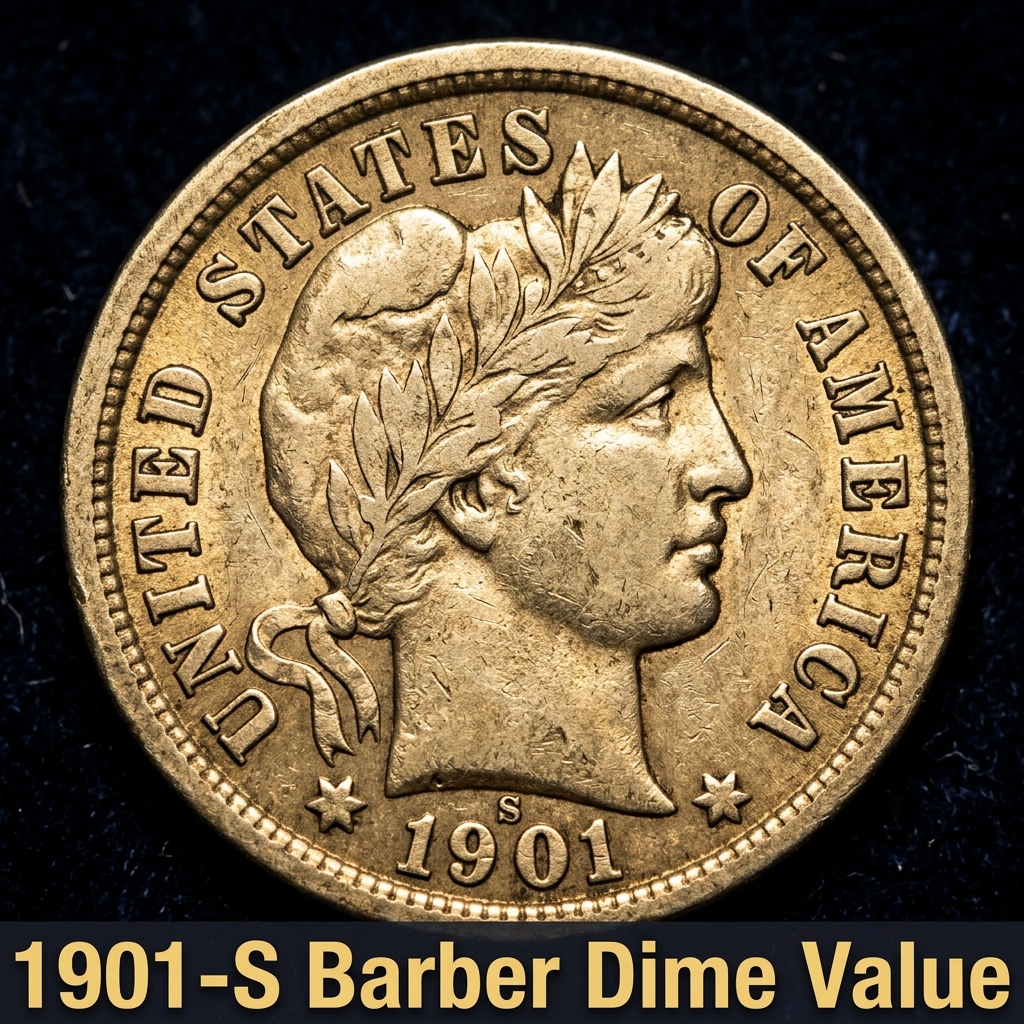
The 1901-S Barber Dime is worth anywhere from $60 in heavily worn condition to over $10,000 for elite uncirculated specimens. This tiny silver coin is a major treasure for casual hunters, as its “S” mint mark signifies a very rare production run from the San Francisco Mint.
How to Identify Your 1901-S Barber Dime
If you’ve discovered an old silver dime in a box of family keepsakes, the first thing you need to look for is the mint mark. The 1901 Barber Dime was struck at three different locations: Philadelphia (no mark), New Orleans (O), and San Francisco (S). To find yours, flip the coin over to the reverse side. Look just below the ribbon on the laurel wreath. If you see a small, clear “S,” you have found one of the most sought-after coins in the series.
Because these coins are over a century old, many are heavily worn. However, even a flat, smooth 1901-S carries significant value because only 593,022 were ever made. To get an instant idea of what your specific coin looks like compared to museum-quality pieces, you can use a free coin identifier app to snap a photo and see its details more clearly. Many users of the CoinHix app find that these digital tools help them spot small details, like the “S” mark, that are hard to see with the naked eye.
Understanding the Value of Your San Francisco Dime
The value of the 1901-S is driven entirely by its scarcity. In the world of numismatics, a “mintage” of under one million is considered very low. Because most of these silver dimes were used in daily commerce during the early 20th century, most surviving examples are in “Good” or “Very Good” condition. In these lower grades, the coin still commands a high price because collectors need it to complete their sets.
When evaluating your find, the leap in price between a worn coin and a shiny, preserved one is staggering. Most people will find coins in the $60 to $150 range. However, if your coin still shows the word “LIBERTY” clearly on Liberty’s headband, the 1901-S dime value can easily climb into the thousands of dollars. Always handle these coins by the edges, as the oils from your skin can damage the delicate silver surface and lower the potential payout.
| Condition / Grade | Estimated Market Value |
|---|---|
| Good (G-4) | $65 – $85 |
| Very Good (VG-8) | $110 – $150 |
| Fine (F-12) | $250 – $350 |
| Very Fine (VF-20) | $550 – $700 |
| Extremely Fine (EF-40) | $1,100 – $1,400 |
| About Uncirculated (AU-50) | $2,400 – $3,000 |
| Mint State (MS-63+) | $6,500 – $15,000+ |
Factors That Influence Grade and Rarity
When professional graders look at a 1901-S Barber Dime, they focus on specific “high points” of the design. On the obverse (the front), they look at the hair above the ear and the wreath on Liberty’s head. If these areas are flat and featureless, the coin is in “Good” condition. If you can see the leaves and the letters of “LIBERTY,” it is a much rarer find. On the reverse, the detail in the corn and wheat inside the wreath determines if the coin is a “Fine” grade or better.
Before you take your coin to a local dealer, it is helpful to do some homework. Using CoinHix can provide you with a baseline gallery of images to compare against your own coin. This prevents you from being underpaid by someone looking to get a deal on a rare “S” mint dime. Remember, even a damaged 1901-S is worth far more than its silver content, which is only about $2 in raw metal.
Tips for Selling Your Vintage Silver Coins
Selling a high-value item like the 1901-S requires a bit of strategy. For coins worth more than $500, most experts recommend getting them “certified” by a grading service like PCGS or NGC. A certified grade guarantees the authenticity and the condition of the coin, making it much easier to sell at an auction or to a serious collector. For everyday people, this process might seem intimidating, but the potential increase in profit is often worth the small grading fee.
If your coin is in lower condition, selling to a reputable local coin shop or through a verified online marketplace is often the fastest route. Always check current auction records to see what similar coins have sold for recently. By keeping the CoinHix app handy on your phone, you can track market trends and ensure you are getting a fair price for your piece of American history.
Q: How can I tell if my 1901-S Barber Dime is a fake?
A: Counterfeiters sometimes “glue” an “S” onto a common Philadelphia dime. Check the mint mark closely with a magnifying glass; it should look like a natural part of the coin’s surface, not a separate piece.
Q: Should I clean my 1901-S dime to make it look newer?
A: No! Never clean your coins. Cleaning causes micro-scratches on the surface that professional collectors can spot instantly, and it can reduce the value of a rare coin by 50% or more.
Q: Why is the 1901-S so much more expensive than the 1901-P?
A: The Philadelphia Mint (1901-P) produced over 18 million dimes, while the San Francisco Mint produced fewer than 600,000. Low supply and high collector demand make the “S” version nearly 30 times more valuable in many grades.