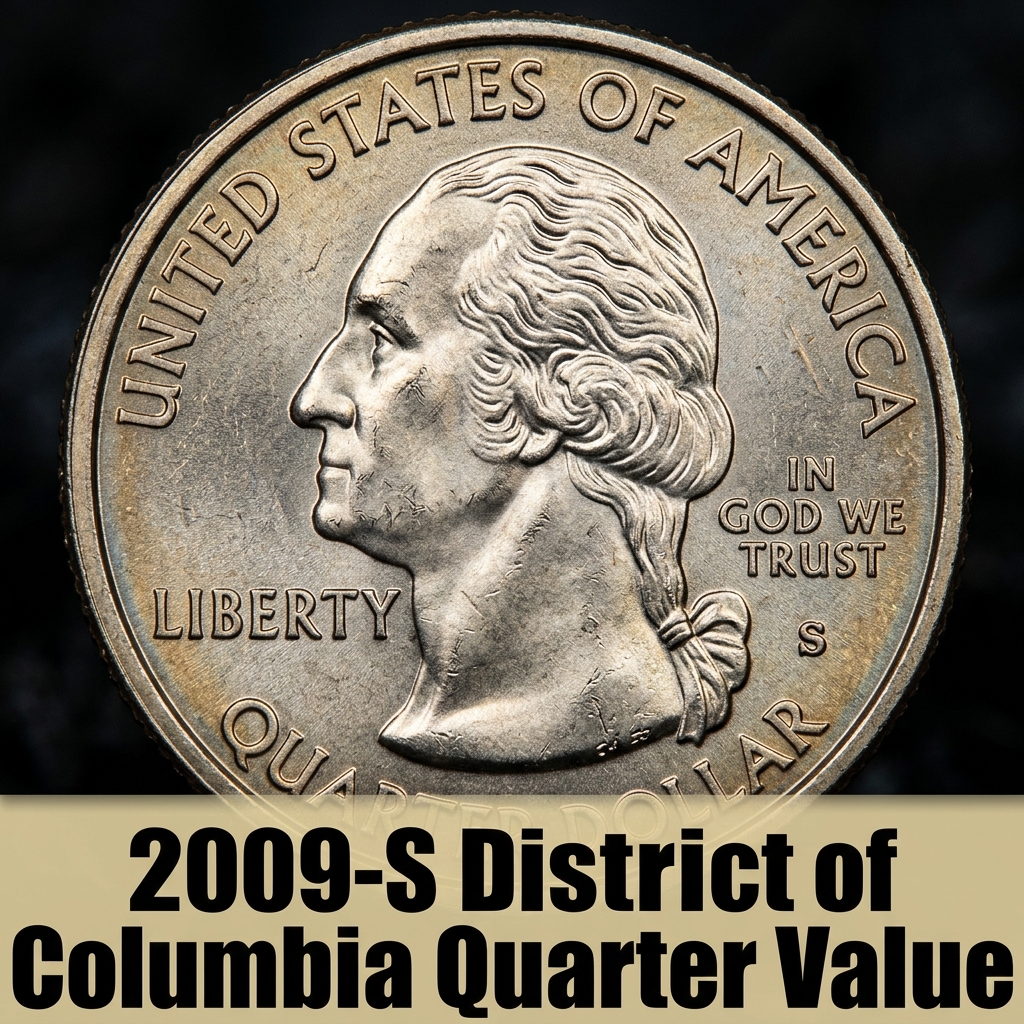
The 2009-S District of Columbia Quarter is worth anywhere from $2 in typical proof condition to over $50 for high-grade silver versions. While most of these coins were produced for collectors, finding one in your change or an old desk drawer is always an exciting discovery for any American.
Understanding the Special Nature of the 2009 S District of Columbia Quarter
In 2009, the United States Mint expanded the 50 State Quarters Program to include the District of Columbia and five U.S. Territories. Unlike the standard quarters you find in your pocket everyday, the “S” mint mark indicates that these coins were struck at the San Francisco Mint specifically for collectors.
If you have stumbled upon one of these coins, you might be wondering about the free coin identifier app tools available today. Most “S” quarters from this year are “Proof” coins, meaning they were struck multiple times with specially polished dies to create a mirror-like finish.
If you are unsure whether your coin is a standard circulation strike or a special proof, using the CoinHix app can help you distinguish the mirror-like surfaces from the satin finish of a regular quarter. These coins feature the famous Duke Ellington seated at a piano, making them one of the most artistically praised designs in modern American coinage.
Standard Clad vs Silver Proof Values
One of the most important things to determine is whether your 2009-S DC Quarter is made of the standard copper-nickel “clad” composition or 90% silver. The San Francisco Mint produced both versions. The clad proof version generally has a copper stripe visible on the edge of the coin, while the silver version has a solid white/silver edge.
The 2009-S DC quarter value for a silver proof is significantly higher simply because of the precious metal content. Even if the coin is somewhat scratched, it will always be worth its weight in silver. However, if the coin is in a “PR70” grade—meaning it is perfect—the value can climb significantly.
Many people use the CoinHix app to compare their coin’s condition against high-resolution images of graded specimens. This helps you decide if it is worth sending your quarter to a professional grading service like PCGS or NGC, which can cost more than the coin’s actual value in lower grades.
What Affects the Market Price for the 2009-S Quarter
When evaluating your coin, “eye appeal” is the biggest factor. Collectors look for deep cameo (DCAM) effects, where the frosted design of Duke Ellington stands out sharply against a deep, dark, reflective background. If your coin has fingerprints, scratches, or “haze” from being stored in a humid environment, the value will drop toward the lower end of the spectrum.
The mintage for the 2009-S District of Columbia clad proof was approximately 2.1 million, while the silver proof saw a lower mintage of about 990,000. These numbers are relatively low compared to the hundreds of millions of quarters struck in Philadelphia or Denver.
Lower mintages usually mean higher long-term potential for value growth. If you are tracking a collection, the CoinHix app allows you to log your finds and see real-time market trends. This is particularly useful for the 2009 series, as the limited production window during the Great Recession led to fewer coins being saved by the general public.
| Coin Variation | Condition / Grade | Estimated Value |
|---|---|---|
| 2009-S DC Clad Proof | PR 65 (Clean) | $2.50 – $4.00 |
| 2009-S DC Clad Proof | PR 70 (Perfect) | $25.00 – $35.00 |
| 2009-S DC Silver Proof | PR 65 (Clean) | $12.00 – $18.00 |
| 2009-S DC Silver Proof | PR 70 (Perfect) | $45.00 – $65.00 |
Identifying Rare Errors and Varieties
While the 2009-S District of Columbia Quarters are mostly known for their proof finishes, error hunters are always on the lookout for anomalies. Doubled die errors are the most sought-after. On the DC quarter, look closely at the piano keys or the letters in “Duke Ellington” for any slight doubling of the image.
Another rare occurrence is a “Proof” coin that accidentally found its way into general circulation. If you find an “S” mint mark coin in your pocket change and it looks dull or scratched, it is called an “impaired proof.” These are worth less than their pristine collector counterparts but are still worth more than 25 cents to a curious collector.
Always handle your proof coins by the edges. The oils from your skin can permanently damage the sensitive mirror finish of a proof quarter, instantly lowering its grade and market value. If you think you’ve found an error, use a magnifying glass or a high-zoom camera before attempting to clean the coin—which you should never do!
Frequently Asked Questions about the 2009 S District of Columbia Quarter
Q: Is every 2009 quarter with an “S” mint mark made of silver?
A: No. The San Francisco Mint produced both copper-nickel clad versions and 90% silver versions. Check the edge of the coin; if you see a orange/copper stripe, it is clad. If the edge is solid silver-colored, it is likely the silver version.
Q: Can I find a 2009-S District of Columbia Quarter in my pocket change?
A: It is rare, but possible. These coins were originally sold in sets by the U.S. Mint. Sometimes people break the sets open and spend the coins, or they are stolen and spent. If you find one, it is considered an “impaired proof.”
Q: Why is Duke Ellington on the quarter?
A: Each coin in the 2009 District of Columbia and U.S. Territories program featured a design representative of the location. D.C. chose the legendary jazz musician Duke Ellington to honor the city’s rich musical and cultural history.